
Requisite Variety
A Field Guide to Navigating Complexity - Part 1


“Only variety can destroy variety.”
The Law of Requisite Variety by W. Ross Ashby
A Tension We Know Well
A leader we work with recently said,
“I used to know how to solve problems. Now it’s like I’m solving shadows. Everything I do shifts something else, and I’m not even sure it helped.”
She isn’t alone. Whether in therapy rooms, team retreats, or strategic conversations, we hear a common thread:
Not everything that feels urgent is actually clear. The world throws more at us than we can fully process - emotionally, cognitively, organisationally.
That’s where Ashby Space comes in. It’s a simple, powerful framework derived from Ashby’s Law of Requisite Variety, that helps us understand what it means to adapt well under pressure.
What Is Ashby Space?
Imagine two sliding scales:
On the vertical, the variety of stimuli coming at you—the complexity and unpredictability of the world.
On the horizontal, the variety of your responses—your available options, strategies, capabilities, reflexes, and resources.
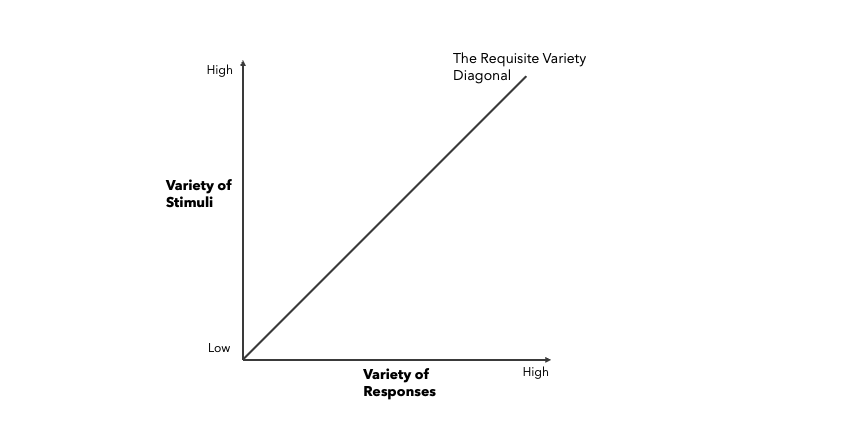
Ashby’s Law of Requisite Variety tells us this:
to survive, your responses must match the complexity of what you’re facing.
Too little variety in responses, and you under-adapt - missing what’s essential.
Too much variety in responses, and you burn out - exhausting energy, attention, or team capacity.
Our focus lies in functional fit, not rigid precision.
In Ashby Space, this balance lives along a diagonal: Where the variety of your responses matches the variety of the world you’re engaging with.
Adaptive Consequences: What Happens Off the Diagonal?
Where you are placed in Ashby Space has real-world consequences.
Adaptation doesn’t mean doing more—it means achieving functional fit: responding with just enough complexity to meet what’s actually happening, without overextending the system’s energy, focus, or coherence.
Here’s what happens when the fit is off:
Above the diagonal: A team sticks to familiar routines while the environment grows more variable. Signals are present - but the team doesn’t reclassify them as meaningful. People quietly disengage, or start reacting emotionally to what feels misaligned.
→ Example from our work: A field service company continued to use the same job planning and pricing model across all assignments - even as weather disruptions, customer urgency, and variation in task complexity increased. Crews were overstretched, delays mounted, and frustration grew. Leadership, relying on past assumptions, believed it was a volume problem - not a complexity one.
Below the diagonal: The organisation response to the environment is too varied. Instead of prioritising, it launches multiple initiatives, changes tools, or alters strategy without grounding. The intention is adaptive, but the execution scatters attention and drains energy.
→ Example from our work: A company replaces the CRM system because of lack of team adaption, assuming the tool was the problem. No real changes in the environment is present. The real issue was a lack of clarity about the tasks to be done - and how they were coordinated. Once the team reframed the work itself, the tool became secondary.
In both cases, the organisation was out of sync with the real complexity of its environment - not because it wasn’t trying, but because its internal map hadn’t updated.
Perfection isn’t the goal. Instead, proportion becomes our compass for staying along the diagonal.
It means tuning your response to the actual signal - not over-reacting to noise, and not mistaking new conditions for old ones.
Sometimes, adaptation means acting.
Sometimes, it means seeing differently first.
Adaptive Intelligence: Not Everyone Has the Same Range
Different organisms, people, teams, and organisations adapt in different ways.
A hummingbird and a human both face complex environments. One survives through lightning-fast reflexes. The other survives by anticipating, coordinating, and creating shared meaning.
In human settings - families, teams, and businesses - our ability to adapt doesn’t just come from intelligence. It comes from relationships, language, and practices that help us notice, interpret, and respond together.
Adaptiveness isn’t just about thinking harder.
It’s about making sense, making choices, and doing so within the limits of your available energy, attention, and understanding.
Practice: Where Are You in the Space?
This week, try asking yourself or your team:
Are we seeing more complexity than we’re prepared to handle?
Are we reacting too much or too little?
Are we staying within our adaptive budget—or are we borrowing against future energy?
We’ll explore the deeper terrain of the Ashby Space next time diving into what impact the inner representation of your environment has to your ability to respond.
But for now, it’s enough to begin noticing the shape of the space itself—and the way you move through it.
Further reading
Ashby, W. Ross (1957): In Introduction to Cybernetics. Chapman & Hall LTD.
Boisot, MAx and McKelvey (2011): Complexity and Organization-Environment Relations: Revisiting Ashby’s Law of Requisite Variety. The SAGE Handbook of Complexity and Management